
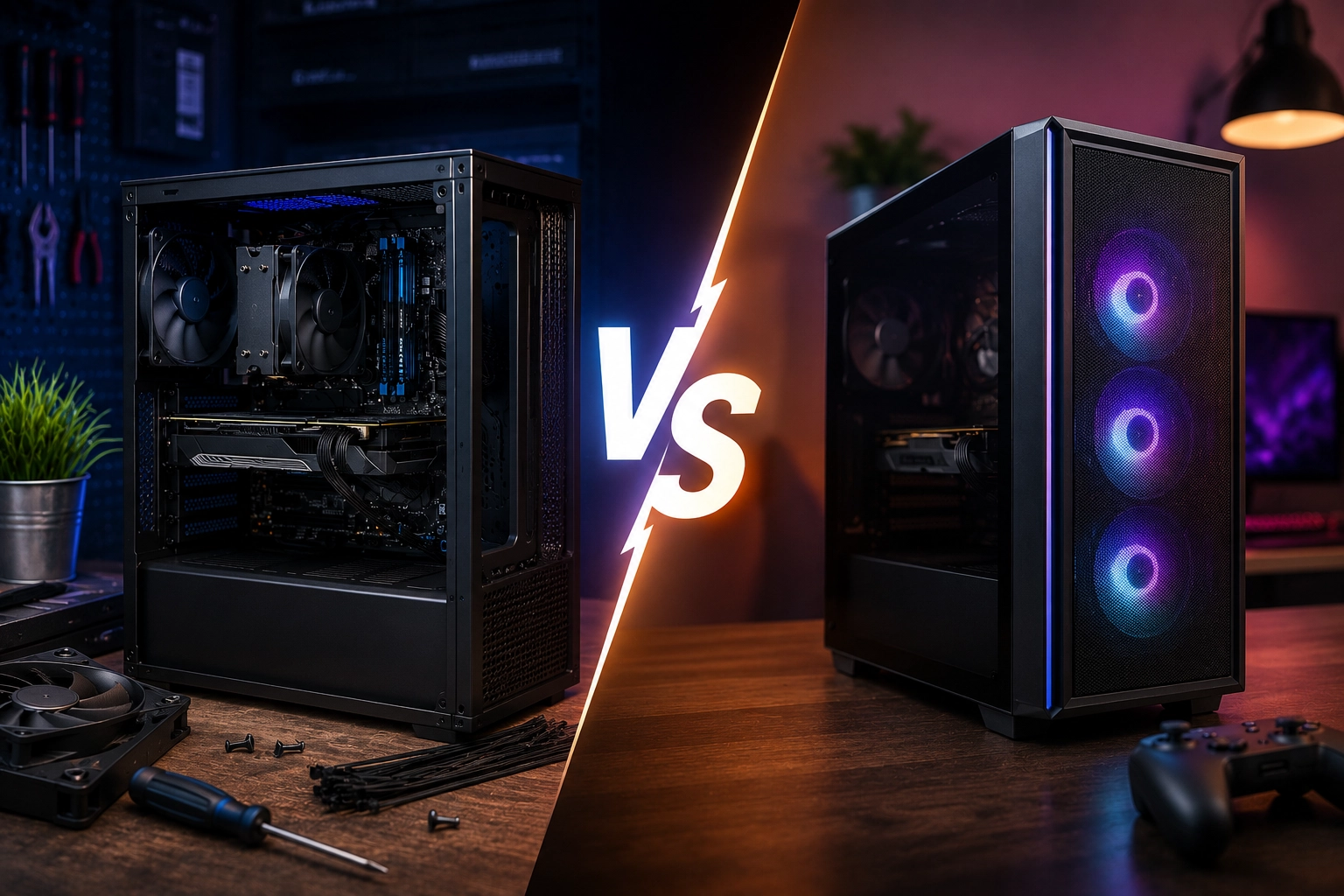
Every gaming forum will tell you that building your own PC is cheaper and that pre-builts are a rip-off. Every retailer will tell you the opposite. Both are selling you something.
The honest answer is that it depends on the budget, on how long you want the machine to last, and on how much of your own time you want to spend on it. Here is how the two options really compare.
What “pre-built” and “custom-built” actually mean
A pre-built is a fixed configuration assembled in volume. The parts list is decided in advance, the machine is tested, and you buy it off the shelf.
A custom build starts with what you want to play, at what resolution and frame rate, and works backwards to a parts list chosen for that. Same assembly and testing, but every component in the case is there for a reason you agreed to.
The important part is that “custom” does not have to mean “expensive”. Very often it means the money lands in the components that affect your frame rate instead of the ones that do not.
Where the money goes
The single biggest lever on gaming performance is the graphics card. It typically deserves the largest slice of the budget, followed by the CPU, then memory, then storage.
Where pre-builts commonly disappoint is in the parts nobody advertises:
- Power supply. A strong GPU paired with a bargain PSU is a machine that crashes under load and, in the worst cases, takes other components with it. This is the most common corner cut in budget pre-builts.
- Cooling and case airflow. A hot GPU and CPU will throttle, meaning you paid for performance you never see. Airflow is unglamorous and it matters.
- Motherboard. A cheap board can limit memory speed, restrict how far you can upgrade the CPU later, and leave you short on ports and M.2 slots.
- Memory configuration. A single stick instead of two costs the machine real frame rate in many games, because it halves memory bandwidth.
A custom build lets you see all of that on paper before you pay. That transparency is the actual advantage, more than raw price.
When a pre-built is the better call
Pre-builts genuinely win in a few situations.
You need the machine now, this week, without waiting on parts. You want one warranty covering one product rather than tracking individual component warranties. You are buying for someone else, perhaps a teenager or a first-time gamer, and simplicity matters more than optimisation. Or a bundle deal has landed at a price that individual parts cannot match, which does happen when suppliers clear stock.
There is nothing wrong with any of those reasons.
When a custom build is worth it
Custom builds pay off when you have a specific target, such as high refresh rate 1440p in competitive shooters, or 4K in single player titles, and you want the parts matched to that rather than to a marketing bracket.
They also pay off when you plan to upgrade later. Choosing a motherboard, case and power supply with headroom means the next upgrade is a graphics card swap on a Saturday afternoon instead of a whole new machine. Some pre-builts use proprietary boards, cases or power connectors that make that upgrade path awkward or impossible.
And they pay off when the PC is doing more than gaming. Video editing, 3D work, streaming while you play, or running local AI models all shift the balance between CPU cores, memory capacity and video memory in ways a generic gaming spec sheet does not account for.
A quick way to pick your tier
Work out your target first, then spec to it.
1080p, high refresh rate. Competitive shooters and esports titles. The CPU matters more here than people expect, because high frame rates are often CPU limited. A mid-range GPU is plenty. 16GB of memory in two sticks.
1440p, high settings. The current sweet spot for most players. This is where the GPU budget should climb. 16GB to 32GB of memory, and a fast NVMe drive so large games load quickly.
4K, or heavy creative work alongside gaming. Top tier GPU with plenty of video memory, 32GB of memory or more, generous power supply headroom, and cooling designed for sustained load rather than short bursts.
Two things are worth having at every tier: an NVMe SSD as the boot and games drive, and a power supply with room to spare. Both are cheap insurance.
Warranty and support in Australia
Whichever you choose, remember that Australian Consumer Law guarantees apply on top of any manufacturer warranty. Goods must be of acceptable quality and fit for purpose, and those rights are not cancelled by a warranty period ending.
Practically, the question to ask any seller is what happens if a single component fails in eighteen months. With a well-built custom machine from a local shop, the answer should be that the faulty part gets diagnosed and replaced. That is a much better position than shipping an entire tower interstate and waiting.
Buying locally also means someone can actually look at the machine. That is worth more than most people realise until the day something goes wrong.
Build it with Telespace
Telespace builds custom gaming PCs to your budget and your games, and also stocks pre-built and bundle options if you want something ready to go. We can talk thro